Introduction
The NFL matchup between the Denver Broncos vs New York Jets Match Player Stats presented a compelling clash of AFC contenders, emphasizing contrasting offensive strategies and defensive approaches. Denver entered the contest relying on quarterback Russell Wilson’s experience, combining short-to-intermediate passing with a controlled rushing attack designed to dominate time of possession. New York, led by quarterback Aaron Rodgers, employed a high-tempo offensive scheme featuring aggressive downfield passing, complemented by a balanced running game. Over the course of four quarters, statistical analysis revealed key differences in efficiency, explosive playmaking, third-down conversions, and red-zone execution.
First Quarter Offensive Flow and Momentum
Denver Broncos vs New York Jets Match Player Stats initiated the game with a measured 10-play, 66-yard opening drive that highlighted balanced offensive execution. Russell Wilson completed six of eight passes, mixing intermediate throws with checkdowns to running backs. The drive concluded with a 14-yard touchdown pass to wide receiver Jerry Jeudy, giving the Broncos an early edge. New York countered with an 8-play, 58-yard drive, advancing methodically and culminating in a field goal. By the conclusion of the first quarter, Denver had accumulated 124 total yards compared to New York’s 82, establishing initial statistical dominance and demonstrating effective time-of-possession control.
Russell Wilson’s Passing and Leadership
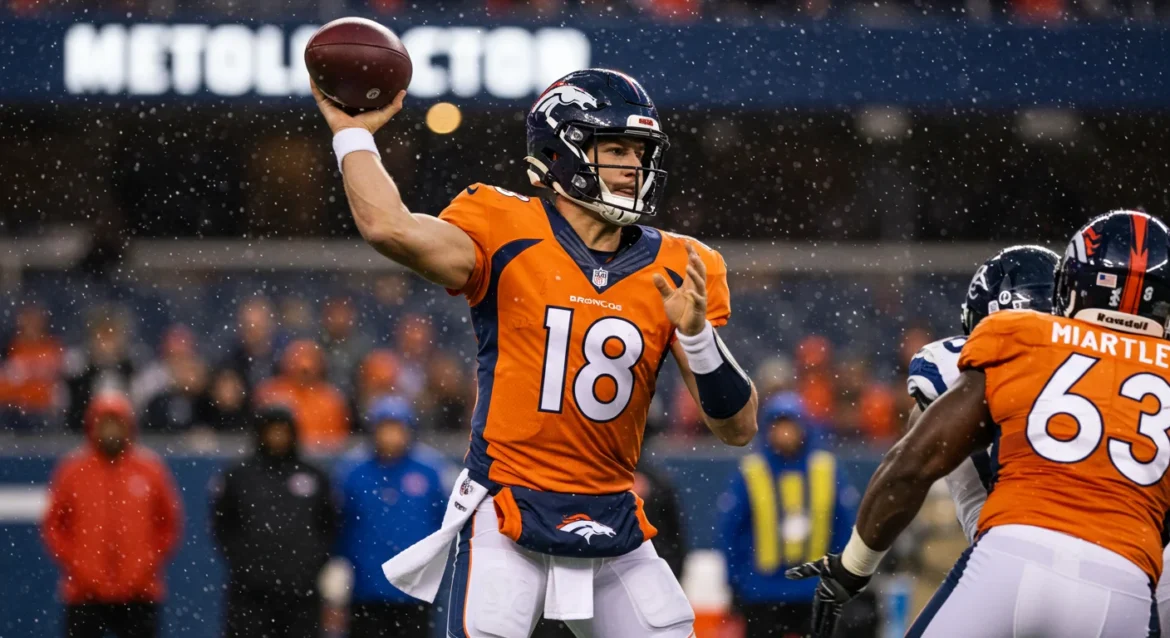
Russell Wilson delivered a controlled Denver Broncos vs New York Jets Match Player Stats and efficient performance, completing 27 of 39 passes for 305 yards, 2 touchdowns, and 1 interception. Averaging 7.8 yards per attempt, Wilson displayed precise timing and decision-making, particularly in intermediate passing lanes. His 36-yard completion to Courtland Sutton in the second quarter created a key scoring opportunity, while a 21-yard red-zone touchdown pass in the third quarter extended Denver’s lead. Wilson’s overall passer rating exceeded 105, highlighting his ability to maintain offensive rhythm while mitigating turnovers.
Broncos Receiving Corps and Target Distribution
Wide receiver Jerry Jeudy led the receiving corps with 9 receptions for 118 yards and a touchdown, consistently gaining separation and converting critical third downs. Denver Broncos vs New York Jets Match Player Stats Courtland Sutton added 7 catches for 87 yards, effectively stretching the field vertically. Tight end Greg Dulcich contributed 5 receptions for 46 yards, primarily on short-to-intermediate routes. Running back Javonte Williams factored into the passing game with 3 receptions for 32 yards. The balanced target distribution ensured that the Broncos’ passing attack remained unpredictable, preventing the Jets from focusing on a single receiver.
Denver Rushing Attack
Javonte Williams contributed 92 rushing yards on 18 carries, averaging 5.1 yards per attempt, and added 1 rushing touchdown. His longest run of 28 yards in the third quarter helped flip field position and sustain a scoring drive. Combined with Wilson’s occasional scrambles, the Denver Broncos vs New York Jets Match Player Stats totaled approximately 150 rushing yards, demonstrating an effective multi-dimensional offense that kept the Jets’ defense off balance.
Aaron Rodgers’ Passing Performance
Aaron Rodgers led the Jets’ offensive attack with 26 completions on 40 attempts for 289 yards, 2 touchdowns, and 2 interceptions. Averaging 7.2 yards per attempt, Rodgers showed his trademark timing and accuracy on intermediate and deep passes but struggled with Denver Broncos vs New York Jets Match Player Stats pass rush. His 32-yard touchdown pass to Garrett Wilson in the second quarter narrowed the deficit, but a key interception in the fourth quarter halted a promising drive. Rodgers also contributed modest rushing yardage, totaling 14 yards on scrambles designed to extend plays.
Jets Receiving Leaders
Wide receiver Garrett Wilson led New York with 8 receptions for 112 yards and a touchdown, frequently exploiting single coverage in the intermediate zones. Tight end C.J. Uzomah added 6 receptions for 61 yards, contributing as a reliable safety valve. Running back Breece Hall contributed 4 receptions for 33 yards and added 76 rushing yards on 17 carries, providing balance to the Jets’ offensive attack. Despite these efforts, Denver Broncos vs New York Jets Match Player Stats struggled to sustain drives in critical moments due to turnovers and third-down inefficiency.
Defensive Performances and Impact Plays
Denver Broncos vs New York Jets Match Player Stats defense recorded four sacks, eight quarterback hits, and one interception that shifted momentum in the third quarter. Linebacker Justin Strnad led the team with 10 tackles and a forced fumble. Defensive end Dre’Mont Jones contributed 1.5 sacks and multiple quarterback pressures, consistently disrupting Rodgers’ timing. The secondary limited explosive plays, allowing the Broncos to maintain a statistical edge in defensive efficiency. New York’s defense registered three sacks, one forced fumble, and an interception. Linebacker Quinnen Williams led the Jets with 11 tackles and two tackles for loss, while cornerback Sauce Gardner added pass breakups that prevented big gains.
Third-Down Efficiency and Time of Possession
Third-down conversions were pivotal to controlling the flow of the game. Denver Broncos vs New York Jets Match Player Stats converted 9 of 15 third-down attempts, sustaining long drives and controlling clock management. New York converted 5 of 13 third downs, often facing long-yardage situations due to early-down inefficiency. Time of possession favored the Broncos at approximately 34 minutes compared to the Jets’ 26 minutes, allowing Denver to dictate tempo and manage defensive energy.
Red-Zone Efficiency and Turnover Margin
Inside the red zone, Denver Broncos vs New York Jets Match Player Stats converted 4 of 5 possessions into touchdowns, demonstrating precise execution in critical scoring situations. New York converted 2 of 3 red-zone trips into touchdowns while settling for a field goal on another drive. The turnover differential slightly favored Denver due to a fourth-quarter interception that halted a potential Jets scoring opportunity. These marginal advantages played a significant role in determining the statistical outcome.
Fourth Quarter Execution and Closing Strategy
In the final quarter, Denver Broncos vs New York Jets Match Player Stats emphasized ball control and risk mitigation, blending rushing plays with high-percentage short passes. Javonte Williams’ consistent ground gains consumed clock and limited New York’s offensive opportunities. The Jets attempted a late rally, but a decisive interception by Broncos cornerback Pat Surtain II ended the drive and effectively secured the outcome. Denver averaged 6.1 yards per play in the fourth quarter compared to New York’s 4.8, reflecting superior efficiency in the closing stages of the game.
Comprehensive Statistical Summary
By the end of the contest, Denver Broncos vs New York Jets Match Player Stats totaled approximately 455 total yards, including 305 passing and 150 rushing yards. The Jets recorded roughly 375 total yards, with 289 passing and 86 rushing yards. Denver averaged 6.4 yards per play, compared to New York’s 5.2. Russell Wilson, Jerry Jeudy, and Javonte Williams anchored the Broncos’ offensive success, while Justin Strnad and Dre’Mont Jones contributed key defensive plays. Aaron Rodgers, Garrett Wilson, and Breece Hall provided strong statistical performances for the Jets, but turnovers and inefficiencies in high-leverage situations ultimately limited their effectiveness.
Conclusion
The Denver Broncos vs New York Jets Match Player Stats matchup demonstrated the importance of balanced offense, quarterback efficiency, and defensive pressure in determining outcomes. Russell Wilson’s 305 passing yards combined with Javonte Williams’ rushing and Jerry Jeudy’s receiving efforts established a multi-dimensional offensive attack that challenged the Jets’ defense consistently. Aaron Rodgers provided 289 passing yards and two touchdowns, while Breece Hall and Garrett Wilson contributed to New York’s production, yet turnovers and situational inefficiency prevented a sustained comeback. Ultimately, Denver’s superior third-down conversion, red-zone efficiency, and time-of-possession control secured a statistically supported victory.
You May Also Read: Indianapolis Colts vs Baltimore Ravens Match Player Stats