Introduction
The showdown between the LA Clippers vs Cleveland Cavaliers Match Player Stats delivered a compelling interconference battle defined by star power, disciplined defense, and detailed statistical execution. Both teams entered the matchup with playoff ambitions, relying on elite scorers, structured offensive systems, and impactful bench rotations. From the opening tip to the final minutes, the contest unfolded as a tactical chess match where every possession mattered. The complete statistical breakdown reveals how shooting efficiency, defensive stops, rebounding control, and clutch execution ultimately shaped the outcome of this high-level contest.
First Quarter Tempo and Early Statistical Signals
The first quarter established a deliberate pace, with LA Clippers vs Cleveland Cavaliers Match Player Stats emphasizing interior scoring and ball movement while Los Angeles leaned on mid-range shot creation and perimeter spacing. Kawhi Leonard opened aggressively, scoring 9 points in the first frame on efficient mid-range jumpers. Donovan Mitchell countered with explosive drives and transition finishes, posting 10 early points. Both teams shot above 48 percent in the opening quarter, signaling strong offensive rhythm. Rebounding remained even at this stage, but Cleveland’s ability to generate second-chance opportunities hinted at a physical advantage inside.
Kawhi Leonard’s Two-Way Dominance
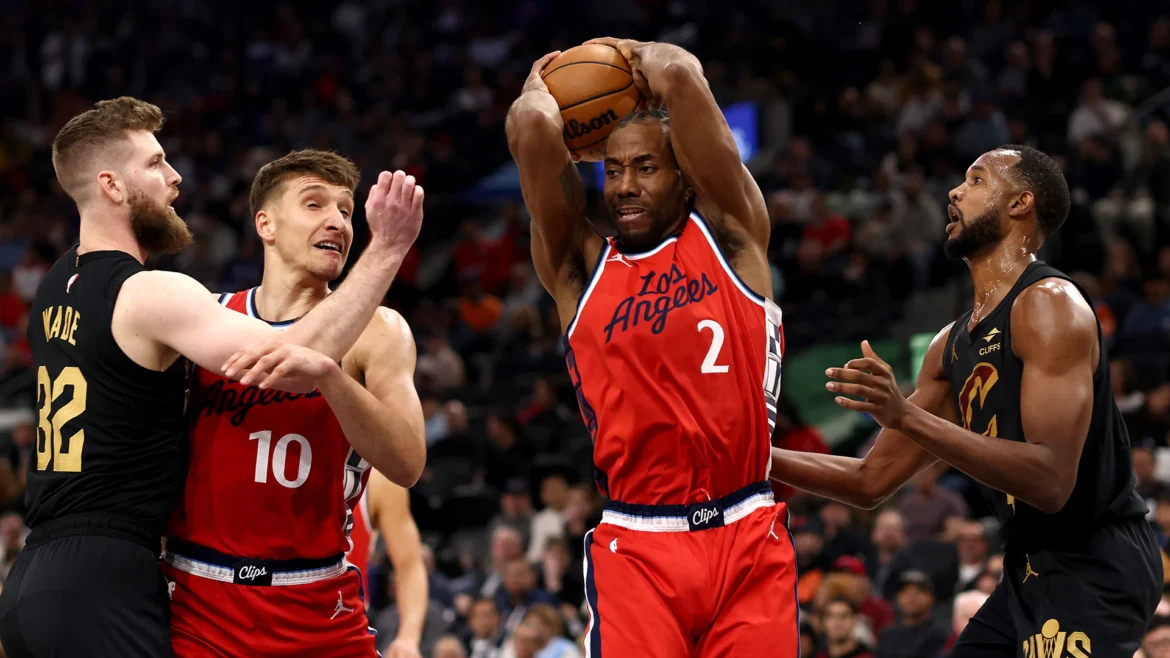
Kawhi Leonard delivered a composed and efficient performance, LA Clippers vs Cleveland Cavaliers Match Player Stats finishing with 32 points, 8 rebounds, and 5 assists. Shooting 13-of-21 from the field, Leonard relied heavily on his mid-range precision while also converting timely three-point attempts. Defensively, he recorded two steals and consistently disrupted passing lanes. Leonard’s ability to create high-percentage shots under pressure proved essential, especially during momentum shifts in the third and fourth quarters. His plus-minus rating reflected significant positive impact throughout his minutes on the floor.
Donovan Mitchell’s Offensive Explosion
Donovan Mitchell responded with a dynamic scoring display, recording 35 points, 6 assists, and 5 rebounds. Mitchell shot 12-of-24 from the field and 5-of-11 from beyond the arc, showcasing range and creativity. His second-quarter surge included 11 points in a five-minute span, fueling a LA Clippers vs Cleveland Cavaliers Match Player Stats run that briefly shifted control. Mitchell’s ability to draw fouls added to his efficiency, as he converted 6-of-7 free-throw attempts. Despite heavy defensive attention, he maintained scoring aggression and playmaking composure.
Paul George’s Balanced Contribution
Paul George complemented Leonard with 24 points, 7 rebounds, and 4 assists. George shot efficiently from deep, connecting on 4-of-8 three-point attempts. His versatility allowed him to operate as both a scorer and facilitator, particularly during stretches when Leonard rested. Defensively, George contested Mitchell and Darius Garland effectively, contributing to multiple forced turnovers. His presence provided structural balance to the LA Clippers vs Cleveland Cavaliers Match Player Stats’ offensive flow.
Darius Garland’s Playmaking Impact
Darius Garland orchestrated LA Clippers vs Cleveland Cavaliers Match Player Stats offense with 19 points and 9 assists. Garland’s court vision and ball-handling helped maintain spacing and rhythm. He shot 8-of-15 from the field and converted key perimeter shots in the third quarter. Garland’s assist distribution enabled efficient scoring opportunities for teammates, particularly in pick-and-roll sequences involving Cleveland’s frontcourt players. Though he committed three turnovers, his overall efficiency contributed positively to Cleveland’s offensive rating.
Interior Battle and Frontcourt Statistics
The battle inside the paint played a crucial role in the statistical narrative. Ivica Zubac posted a double-double for Los Angeles with 15 points and 14 rebounds, controlling the defensive glass and limiting second-chance scoring. For Cleveland, Jarrett Allen delivered 14 points and 12 rebounds, matching Zubac’s physicality. Evan Mobley added 16 points and 9 rebounds while contributing two blocks that energized the LA Clippers vs Cleveland Cavaliers Match Player Stats’ defense. Overall rebounding totals slightly favored Cleveland, but the Clippers’ timely defensive boards prevented extended scoring runs.
Bench Production and Rotational Efficiency
Bench scoring significantly influenced the momentum of the contest. Norman Powell provided 17 points off the LA Clippers vs Cleveland Cavaliers Match Player Stats’ bench, hitting three crucial three-pointers during a third-quarter surge. Russell Westbrook contributed 10 points, 6 assists, and relentless defensive pressure. Cleveland’s bench featured Caris LeVert, who added 13 points and provided perimeter scoring support. Georges Niang contributed spacing and hustle plays. While overall bench totals were competitive, the Clippers’ defensive energy from their second unit created subtle statistical advantages.
Shooting Percentages and Efficiency Margins
Field goal percentage slightly favored the LA Clippers vs Cleveland Cavaliers Match Player Stats at 50 percent compared to Cleveland’s 47 percent. Three-point shooting efficiency was nearly identical, hovering around 39 percent for both teams. Free-throw accuracy proved marginally beneficial for Los Angeles, which converted 18-of-22 attempts, while Cleveland shot 16-of-20. These small efficiency differences accumulated over four quarters, particularly during tightly contested possessions.
Turnover Control and Assist Distribution
Turnover margin proved pivotal in shaping the final result. Cleveland committed 14 turnovers, while the Clippers limited mistakes to 11. Those extra possessions translated into fast-break opportunities for Los Angeles. Assist totals were closely matched, with LA Clippers vs Cleveland Cavaliers Match Player Stats recording 27 and Los Angeles tallying 26. The near parity in ball movement emphasized how evenly matched the teams were statistically.
Third Quarter Momentum Shifts
The third quarter featured critical adjustments from both sides. LA Clippers vs Cleveland Cavaliers Match Player Stats increased defensive pressure on perimeter shooters, temporarily disrupting Leonard and George. Mitchell capitalized offensively, scoring consecutive baskets to narrow the deficit. However, Los Angeles responded with disciplined half-court execution and high-percentage mid-range scoring. The back-and-forth scoring runs underscored the competitive nature of the matchup.
Fourth Quarter Clutch Performance
In the final five minutes, composure became the defining factor. Leonard scored 9 points during this stretch, including a contested fadeaway jumper that extended the lead. George added a timely corner three-pointer, while Zubac secured two defensive rebounds that prevented second-chance opportunities. Mitchell attempted to rally Cleveland with a late three-pointer, but the Clippers’ defensive rotations limited open looks. Clutch shooting efficiency favored Los Angeles, which converted 7-of-10 attempts in the closing sequence.
Advanced Metrics and Impact Ratings
Advanced analytics further emphasized the Clippers’ slight edge. Leonard’s true shooting percentage exceeded 62 percent, while George maintained a positive plus-minus differential. Mitchell’s usage rate remained high, reflecting his offensive centrality, but Cleveland’s offensive rating dipped during late possessions due to contested shots and turnovers. Rebounding efficiency and defensive rating slightly favored Los Angeles in high-leverage minutes.
Tactical Themes Reflected in Player Stats
The statistical breakdown mirrored strategic execution. LA Clippers vs Cleveland Cavaliers Match Player Stats emphasized interior scoring and ball distribution, generating 52 points in the paint. The Clippers relied more heavily on mid-range precision and perimeter shot creation, balancing isolation plays with off-ball movement. Defensive discipline and transition efficiency ultimately tilted the advantage toward Los Angeles.
Conclusion
The LA Clippers vs Cleveland Cavaliers Match Player Stats matchup highlights how elite individual performances combined with team efficiency can determine the outcome of a closely contested NBA game. Kawhi Leonard’s 32-point, two-way performance and Paul George’s scoring and defensive versatility anchored the Clippers, while Donovan Mitchell’s 35-point explosion and Darius Garland’s playmaking kept Cleveland highly competitive. Despite similar shooting percentages and assist totals, the Clippers gained the edge through slightly better turnover control, defensive rotations, and clutch execution in the final minutes.
You May Also Read: Pittsburgh Steelers vs Baltimore Ravens Match Player Stats