Introduction
The clash between the 49ers vs New York Giants Match Player Stats showcased a dynamic contrast in offensive efficiency, defensive pressure, and overall execution. Entering the matchup, San Francisco carried momentum built on a balanced offensive system and a disciplined defensive unit, while New York sought to establish rhythm through a developing offensive line and a mix of short passing and situational rushing. From kickoff to the final whistle, the game evolved into a demonstration of how statistical dominance in key areas—total yardage, third-down efficiency, red-zone production, and turnover margin—can determine the outcome of a high-profile NFL contest. By the end of regulation, the 49ers had established a clear advantage in overall production, but the detailed player statistics reveal the individual efforts that shaped the flow of the game.
First Quarter Momentum and Offensive Establishment
The opening quarter reflected 49ers vs New York Giants Match Player Stats commitment to early tempo and offensive control. The 49ers executed a 12-play, 78-yard drive to open the scoring, averaging 6.5 yards per play and converting two critical third downs. Quarterback Brock Purdy displayed precision passing on intermediate routes, while Christian McCaffrey contributed both as a runner and receiver. The Giants responded with a shorter possession that netted 41 yards before stalling near midfield. By the end of the first quarter, San Francisco had accumulated 142 total yards compared to New York’s 58, establishing an early statistical imbalance that foreshadowed the rest of the contest.
Brock Purdy’s Passing Efficiency and Command
Brock Purdy delivered an efficient and composed 49ers vs New York Giants Match Player Stats performance, completing 25 of 34 passes for 287 yards and 2 touchdowns without an interception. Purdy’s completion rate of nearly 74 percent reflected sharp decision-making and effective protection from the offensive line. His yards-per-attempt average of 8.4 illustrated the 49ers’ ability to generate chunk plays without sacrificing accuracy. A 32-yard touchdown strike in the second quarter highlighted his timing and trust in his receivers, while consistent short-to-intermediate completions sustained lengthy drives that controlled time of possession. Purdy’s passer rating exceeded 115, underscoring a near-flawless outing in terms of ball security and efficiency.
Christian McCaffrey’s Dual-Threat Production
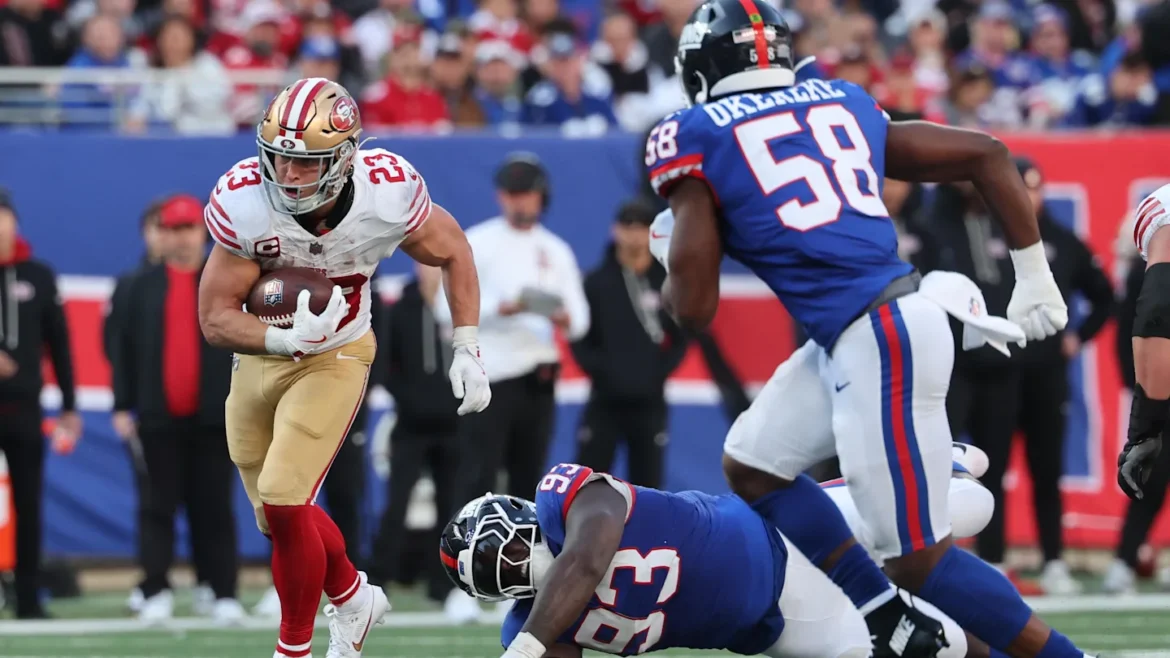
Christian McCaffrey once again demonstrated his versatility by contributing 104 rushing yards on 19 carries and adding 6 receptions for 58 receiving yards and a touchdown. His 21-yard rushing burst late in the second quarter shifted field position and set up another scoring opportunity. McCaffrey averaged 5.5 yards per carry, exploiting defensive gaps and forcing the 49ers vs New York Giants Match Player Stats’ linebackers into difficult coverage decisions. His receiving touchdown came on a perfectly executed screen pass that capitalized on aggressive pass rush pressure. McCaffrey’s total yardage exceeded 160 scrimmage yards, cementing his status as the offensive engine for San Francisco.
49ers Receiving Corps and Yardage Distribution
Wide receiver Deebo Samuel recorded 7 receptions for 89 yards, frequently operating in motion and creating mismatches against linebackers. Brandon Aiyuk contributed 5 catches for 74 yards, including a red-zone touchdown reception. Tight end George Kittle added 4 receptions for 49 yards, serving as a reliable option over the middle and delivering key blocks in the run game. The balanced target distribution allowed the 49ers vs New York Giants Match Player Stats’ secondary off balance and prevented defensive overcommitment to any single playmaker.
Giants Quarterback Performance and Passing Analysis
Daniel Jones faced significant defensive pressure throughout the game, completing 22 of 37 passes for 211 yards, 1 touchdown, and 2 interceptions. Jones averaged 5.7 yards per attempt and was sacked five times, limiting the 49ers vs New York Giants Match Player Stats’ ability to sustain long drives. His lone touchdown pass, a 14-yard connection in the third quarter, briefly narrowed the scoring margin. However, an interception late in the fourth quarter halted a promising comeback drive. Jones’ passer rating of 72 reflected the difficulties posed by San Francisco’s defensive front and coverage schemes.
Giants Rushing Attack and Ground Limitations
Saquon Barkley fought for tough yardage, finishing with 68 rushing yards on 17 carries and adding 4 receptions for 33 yards. Despite his effort, Barkley faced stacked defensive fronts and limited running lanes. His longest rush of 18 yards provided a spark in the second quarter, but overall the 49ers vs New York Giants Match Player Stats averaged only 3.8 yards per carry as a team. The inability to establish consistent ground production placed additional pressure on Jones and the passing offense.
Defensive Dominance by the 49ers
49ers vs New York Giants Match Player Stats defense proved decisive, recording five sacks and generating consistent quarterback pressure. Linebacker Fred Warner tallied 10 tackles and a key third-quarter interception. Defensive end Nick Bosa contributed 2 sacks and multiple quarterback hits, disrupting New York’s protection schemes. The 49ers limited the Giants to 289 total yards while allowing only one touchdown. Their red-zone defense forced two field goals and created a turnover on downs, reinforcing their situational dominance.
Giants Defensive Efforts and Key Plays
New York’s defense managed three sacks and forced a fumble that briefly shifted momentum in the second quarter. Linebacker Bobby Okereke recorded 11 tackles, leading the team in defensive stops. Defensive lineman Dexter Lawrence added a sack and two tackles for loss. While these efforts showcased resilience, the 49ers vs New York Giants Match Player Stats struggled to contain McCaffrey and prevent extended drives, ultimately conceding over 430 total yards.
Third-Down Efficiency and Time of Possession
The 49ers converted 8 of 14 third-down attempts, maintaining offensive rhythm and extending possessions. In contrast, the Giants converted only 4 of 13 third-down opportunities, often facing long-yardage situations due to early-down inefficiency. Time of possession favored San Francisco at approximately 33 minutes compared to New York’s 27 minutes. This control of tempo limited the Giants’ offensive opportunities and allowed the 49ers’ defense to remain fresh in critical moments.
Red-Zone Performance and Turnover Margin
San Francisco converted 3 of 4 red-zone trips into touchdowns, demonstrating precision inside the 20-yard line. New York converted just 1 of 3 red-zone appearances into a touchdown, settling for field goals that limited their scoring potential. The turnover margin favored 49ers vs New York Giants Match Player Stats by one, as their defense capitalized on interceptions while protecting the football offensively.
Fourth Quarter Execution and Closing Efficiency
In the final quarter, the 49ers focused on clock management and ball control. McCaffrey’s consistent rushing gains enabled a 10-play drive that consumed nearly six minutes. Purdy’s accurate short passes prevented defensive overcommitment and preserved possession. The 49ers vs New York Giants Match Player Stats attempted a late rally, but defensive pressure and a crucial interception extinguished hopes of a comeback. Statistical comparison in the fourth quarter showed San Francisco averaging 6.2 yards per play versus New York’s 4.9, highlighting the disparity in late-game efficiency.
Overall Statistical Summary and Comparative Metrics
By game’s end, the 49ers accumulated 438 total yards, including 287 passing yards and 151 rushing yards. The Giants recorded 289 total yards, with 211 passing and 78 rushing yards. 49ers vs New York Giants Match Player Stats averaged 6.4 yards per play compared to New York’s 4.7. Penalty yardage remained relatively even, but the 49ers’ ability to avoid costly turnovers and convert third downs proved decisive. Individual performances by Purdy and McCaffrey defined the offensive narrative, while Bosa and Warner anchored a defense that consistently disrupted New York’s rhythm.
Conclusion
The 49ers vs New York Giants Match Player Stats matchup ultimately illustrated how balanced offensive execution and defensive discipline translate into statistical dominance and victory. Brock Purdy’s efficient 287-yard passing performance, combined with Christian McCaffrey’s 160-plus scrimmage yards, established offensive consistency for San Francisco. Meanwhile, the Giants struggled to overcome defensive pressure and limited rushing production despite Daniel Jones’ efforts and Saquon Barkley’s resilience. With superior third-down efficiency, red-zone conversion, and time-of-possession control, the 49ers demonstrated the comprehensive performance necessary to secure a decisive win.
You May Also Read: Baltimore Ravens vs Miami Dolphins Match Player Stats