Introduction
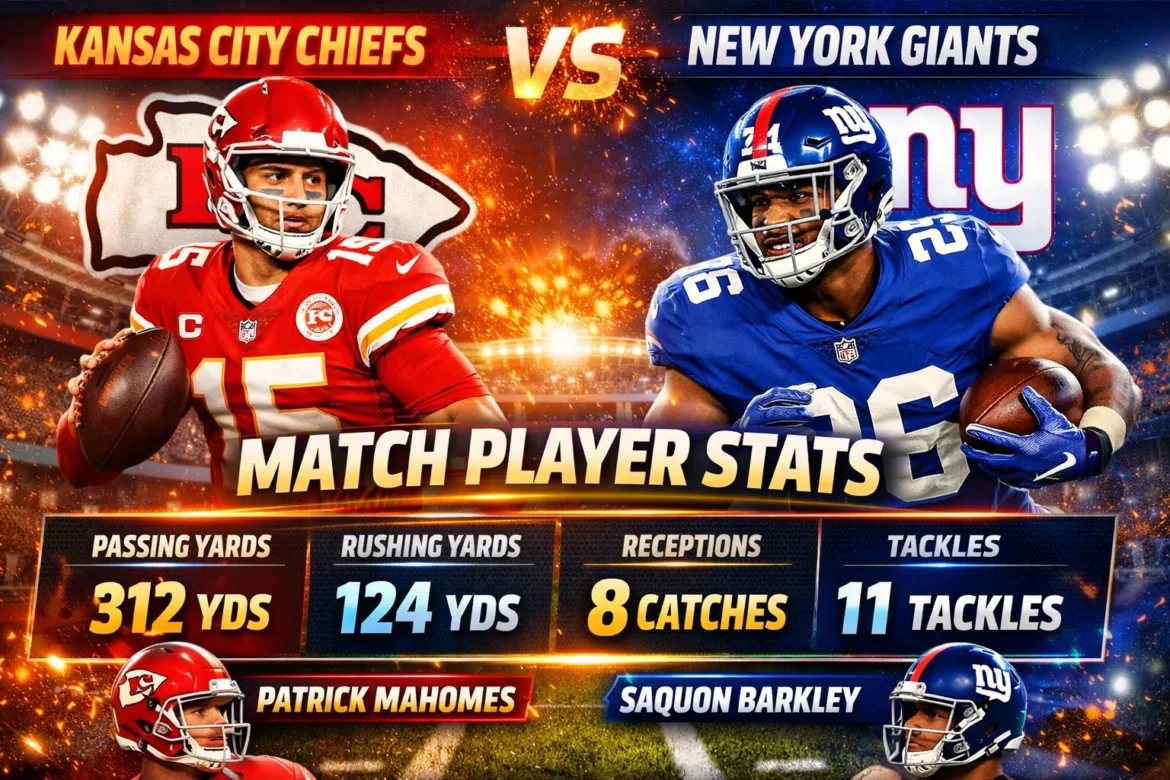
The clash between the Kansas City Chiefs vs New York Giants Match Player Stats and the New York Giants presented a compelling interconference battle defined by quarterback decision-making, defensive discipline, and situational efficiency. Both teams approached the matchup with distinct offensive identities: Kansas City relying on high-powered passing schemes and creative formations, while New York emphasized physical defense and controlled offensive drives. The statistical narrative of the game reflected this contrast, as total yardage, third-down conversions, red-zone execution, and turnover margin ultimately shaped the result. By examining individual player statistics in depth, a clear picture emerges of how each unit performed and which athletes delivered the most impactful contributions.
First Quarter Momentum and Early Statistical Trends
The opening quarter set the tone with Kansas City Chiefs vs New York Giants Match Player Stats establishing early tempo through quick passing concepts and pre-snap motion designed to create mismatches. The Chiefs accumulated 112 total yards in the first quarter, converting two third downs and finishing with an early touchdown drive. The Giants responded with 85 total yards, leaning on short passes and inside runs to maintain balance. Time of possession was nearly even in the opening 15 minutes, but Kansas City’s explosive plays gave them a slight edge in field position. Early defensive statistics showed both teams recording one sack, signaling an intense battle in the trenches from the outset.
Patrick Mahomes’ Passing Efficiency and Command
Patrick Mahomes once again demonstrated elite quarterback play, Kansas City Chiefs vs New York Giants Match Player Stats completing 31 of 44 passes for 347 yards, 3 touchdowns, and 1 interception. Averaging 7.9 yards per attempt, Mahomes effectively distributed the ball across multiple targets while maintaining poise under defensive pressure. His second-quarter touchdown pass of 42 yards showcased arm strength and timing, while a perfectly executed red-zone strike in the third quarter extended Kansas City’s lead. Mahomes’ ability to improvise outside the pocket added 28 rushing yards on four scrambles, including a crucial third-down conversion that sustained a scoring drive. His passer rating exceeded 105, reflecting consistent efficiency despite a single interception caused by tight coverage.
Chiefs Receiving Corps and Target Distribution
Travis Kelce anchored the passing attack with 9 receptions for 121 yards and 1 touchdown, frequently exploiting gaps in zone coverage. Kelce converted five first downs, including two on third-and-long situations that shifted momentum. Wide receiver Rashee Rice contributed 7 receptions for 78 yards and a touchdown, demonstrating reliable route execution across the middle. Marquez Valdes-Scantling added 4 catches for 64 yards, stretching the field vertically and forcing the Giants’ secondary to respect deep threats. Kansas City Chiefs vs New York Giants Match Player Stats receiving unit collectively surpassed 330 passing yards, highlighting the depth and versatility within the offense.
Isiah Pacheco’s Ground Production and Offensive Balance
Isiah Pacheco provided balance with 21 carries for 102 yards and 1 touchdown, averaging nearly five yards per rush. His physical running style wore down the defensive front, particularly during second-half drives aimed at controlling tempo. Pacheco also recorded 3 receptions for 22 yards, contributing in short-yardage passing situations. His 18-yard burst in the fourth quarter positioned the Kansas City Chiefs vs New York Giants Match Player Stats inside the red zone, directly leading to a scoring opportunity. The Chiefs finished with 138 rushing yards as a team, ensuring the Giants could not solely focus on defending the pass.
Daniel Jones’ Performance and Passing Metrics
Daniel Jones led the Kansas City Chiefs vs New York Giants Match Player Stats’ offense with determination, completing 24 of 38 passes for 268 yards, 2 touchdowns, and 2 interceptions. Jones averaged 7.1 yards per attempt and demonstrated mobility with 35 rushing yards on six carries. His first touchdown pass came on a well-executed play-action sequence that caught Kansas City’s defense off balance. However, two second-half interceptions disrupted potential scoring drives, proving costly in a tightly contested game. Despite these turnovers, Jones displayed resilience and leadership, guiding multiple sustained drives that kept New York within striking distance.
Saquon Barkley’s Dual-Threat Contribution
Saquon Barkley played a pivotal role in maintaining offensive balance for Kansas City Chiefs vs New York Giants Match Player Stats, rushing for 94 yards on 19 carries and adding 5 receptions for 41 yards. Barkley’s agility and burst were evident in a 27-yard run during the second quarter that energized the offense. His involvement in screen plays created mismatches against linebackers, allowing the Giants to generate consistent mid-range gains. While he did not record a rushing touchdown, Barkley’s versatility accounted for over 130 total yards from scrimmage, underscoring his central role in New York’s game plan.
Giants Receiving Leaders and Offensive Production
Wide receiver Darius Slayton led the Kansas City Chiefs vs New York Giants Match Player Stats with 6 receptions for 88 yards and 1 touchdown, frequently targeting the sideline to gain chunk yardage. Tight end Darren Waller contributed 7 receptions for 72 yards, serving as a dependable option in intermediate routes. Wan’Dale Robinson added 5 catches for 54 yards and a touchdown in the fourth quarter, briefly narrowing the deficit. Collectively, New York generated over 300 total passing yards, reflecting effective ball movement despite turnovers. However, red-zone inefficiency limited their scoring output compared to Kansas City.
Defensive Standouts and Pressure Statistics
Kansas City Chiefs vs New York Giants Match Player Stats defense generated four sacks and eight quarterback hits, applying steady pressure throughout the game. Defensive tackle Chris Jones recorded 1.5 sacks and multiple disruptions at the line of scrimmage. Linebacker Nick Bolton led the team with 10 tackles and a key third-quarter interception that halted a promising Giants drive. The secondary contributed two pass breakups in the red zone, forcing New York to settle for a field goal on one occasion. The Giants’ defense responded with three sacks, including a forced fumble that briefly shifted momentum. Linebacker Kayvon Thibodeaux registered 2 sacks and six total tackles, showcasing edge-rushing effectiveness.
Third-Down Efficiency and Possession Analysis
Kansas City converted 9 of 15 third-down attempts, maintaining consistent offensive rhythm. The Kansas City Chiefs vs New York Giants Match Player Stats converted 7 of 14, reflecting competitive but slightly less efficient situational execution. Time of possession slightly favored Kansas City at 31 minutes compared to New York’s 29 minutes. Sustained third-quarter drives allowed the Chiefs to manage clock effectively while preserving defensive energy. The marginal advantage in third-down efficiency directly influenced scoring opportunities and field position.
Red-Zone Execution and Turnover Impact
Red-zone efficiency highlighted a critical distinction between the two teams. Kansas City converted 4 of 5 red-zone trips into touchdowns, demonstrating precision play-calling and execution. New York converted 2 of 4 red-zone opportunities, settling for field goals on two drives. The Giants’ two interceptions resulted in lost scoring chances, while Kansas City Chiefs vs New York Giants Match Player Stats capitalized on short-field opportunities created by turnovers. The turnover margin favored the Chiefs by one, a factor that proved pivotal in a competitive contest.
Fourth Quarter Performances and Clutch Statistics
The final quarter emphasized composure and situational awareness. Mahomes orchestrated a 10-play, 75-yard drive culminating in a touchdown pass to Kelce, extending the lead and consuming valuable clock time. Jones responded with a late touchdown pass to Robinson, but a failed fourth-down conversion in the closing minutes sealed the outcome. Statistical comparisons in the fourth quarter showed Kansas City Chiefs vs New York Giants Match Player Stats averaging 6.8 yards per play compared to New York’s 5.2, illustrating more efficient execution during decisive moments.
Advanced Metrics and Comparative Statistical Breakdown
Advanced analytics further illustrate Kansas City Chiefs vs New York Giants Match Player Stats edge. The Chiefs averaged 6.4 yards per play overall, while the Giants averaged 5.7. Mahomes’ adjusted completion percentage approached 73 percent, compared to Jones’ 67 percent. Kansas City’s pressure rate exceeded 30 percent of Giants dropbacks, disrupting timing in critical sequences. Additionally, Kansas City Chiefs vs New York Giants Match Player Stats achieved a higher success rate on early downs, creating manageable third-down scenarios. Although total yardage remained relatively close, efficiency metrics consistently favored the Chiefs, particularly in high-leverage situations.
Conclusion
The Kansas City Chiefs vs New York Giants Match Player Stats matchup underscored the decisive role of efficiency, turnover management, and red-zone execution in determining outcomes at the professional level. Patrick Mahomes’ 347-yard, three-touchdown performance, supported by Travis Kelce’s reliable production and Isiah Pacheco’s balanced rushing attack, propelled Kansas City’s offense to sustained success. Daniel Jones and Saquon Barkley delivered competitive performances for New York, generating significant yardage and maintaining offensive balance, yet turnovers and red-zone limitations ultimately hindered their comeback efforts.
You May Also Read: Buffalo Bills vs Atlanta Falcons Match Player Stats